
Blank Tiles in an Anagram Search: Count Every Missing Letter
A blank tile can stand for a missing letter, but it cannot fill two gaps at once. That simple rule becomes easy to lose when an anagram search checks only whether a letter appears somewhere in the rack. Repeated letters require counts, not just a yes-or-no membership test.
The useful procedure is to compare the candidate’s letter requirements with the rack’s available copies, then add the remaining shortages. This article uses a constructed five-tile rack to make the method visible. It checks what the rack can supply, not whether a move is legal on a particular board.
Keep the blank separate from the ordinary letters
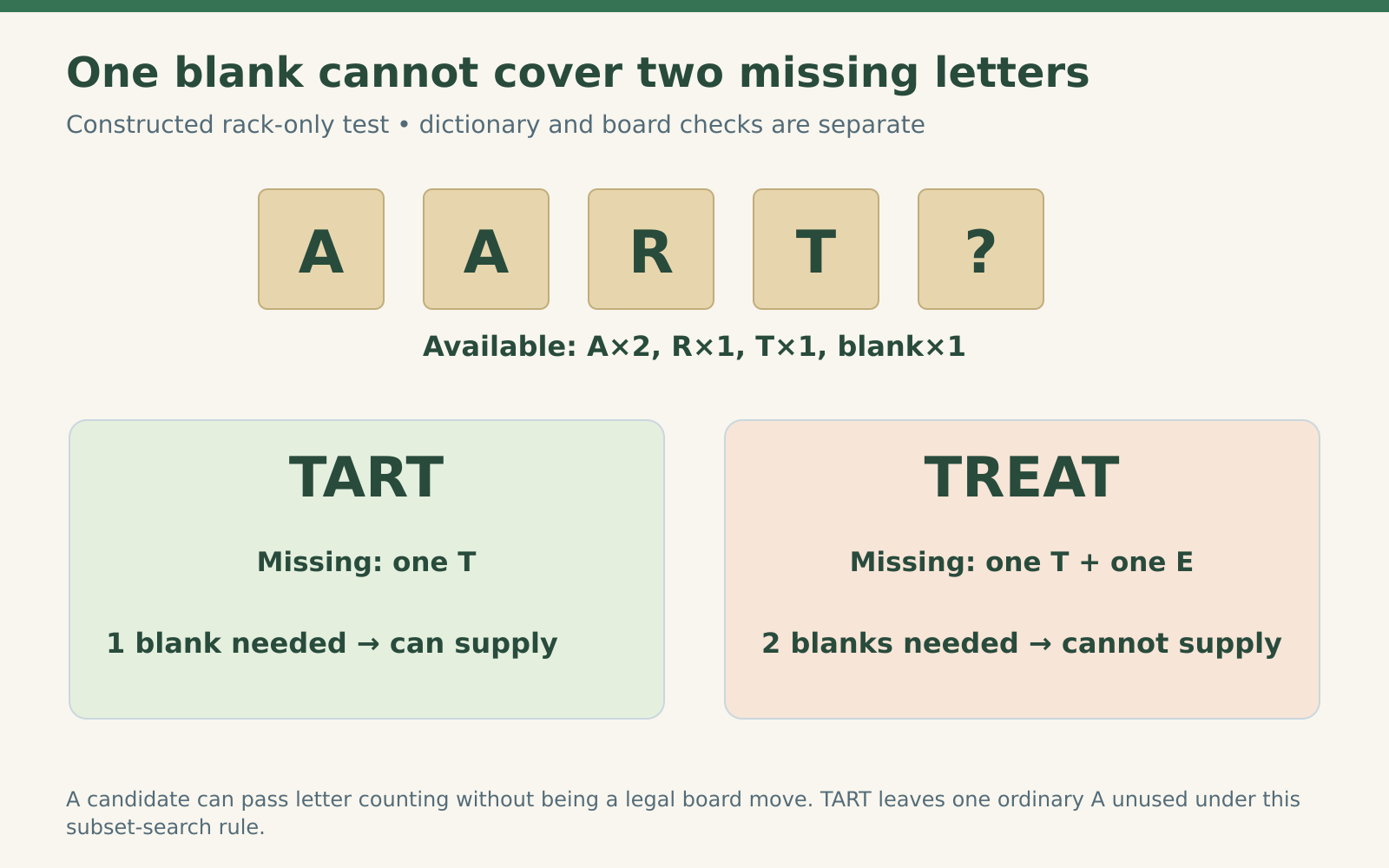
Take the rack A, A, R, T and one blank. Its ordinary-letter counts are A: two, R: one and T: one. Record the blank in its own field instead of pretending it already represents a particular letter.
The official Scrabble instructions explain that a blank represents a chosen letter and has no point value. Once assigned on the board, its identity follows the game’s rules. A search tool should preserve the distinction between a real letter tile and a blank supplying that letter.
In an internal worksheet, a question mark can be a convenient placeholder for an unassigned blank. Explain that convention to the reader. The punctuation character is an input marker; it is not an additional ordinary alphabet letter with its own frequency.
Count the candidate’s requirements
The candidate TART requires two Ts, one A and one R. A check that merely asks whether T, A and R occur in the rack would say yes immediately, but it would not reveal that only one actual T tile is available.
A frequency table retains that missing information. The Python documentation for Counter describes a collection that stores items with their counts. The same idea can be implemented in a spreadsheet, another programming language or a paper table.
For each letter, compare the required number with the available number. Keep only positive shortages. Extra copies of A cannot cancel a shortage of T, because an ordinary A tile cannot be reassigned to a different letter.
Add shortages across all letters
For TART, the T shortage is one, while A and R have no shortage. The total missing-letter count is therefore one. Our one blank can supply it, leaving the extra A tile unused in this rack-only comparison.
Now try TREAT. It requires two Ts, one R, one E and one A. The rack lacks one T and one E, so the total shortage is two. One blank cannot satisfy both requirements, even though the candidate has only five letters.
The general test is straightforward: add each positive required-minus-available difference, then compare that sum with the blank count. The candidate is constructible from the rack alone only when the total shortage does not exceed the number of blanks.
Do not confuse an anagram with a subset word
Some tools require every rack tile to be used, while others return any word that can be formed from a subset. TART uses four of our five tiles, so it can pass a subset search while failing a strict all-tiles anagram requirement.
State which mode the search uses. If all tiles must be used, the candidate length and the treatment of blanks need to match that rule. A tool returning shorter words is not necessarily wrong; it may be answering a different question.
Length is a useful early check but not a complete replacement for letter counts. TREAT has the same length as our rack and still fails the shortage test. TART is shorter and succeeds under the subset rule because its letter requirements can be met.
Keep rack feasibility separate from board legality
A word placed on an actual board may use letters that are already present. It also has to satisfy placement, connection and cross-word rules. The rack-only calculation deliberately leaves those questions outside its scope.
If the board supplies an E, for example, a position involving TREAT must be evaluated with that board contribution explicitly included. The earlier failure does not mean the word can never be played; it means the five rack tiles alone cannot provide every required letter.
Likewise, a candidate that passes the frequency calculation still needs checking against the chosen word list. A sequence of letters can be constructible without being an accepted word. Keep the dictionary choice and version visible rather than implying that letter arithmetic certifies vocabulary.
A shortage calculation can be stored as a small explanation beside each result. Instead of displaying only “possible”, show “one blank supplies T”. This gives the player an immediate way to check the answer against the physical rack and makes repeated-letter errors easier to notice.
Track which letters the blanks supplied
When a candidate passes, retain the shortage assignment. For TART, record that the blank supplies one T. That detail matters when explaining the result and when calculating a score, because the blank does not inherit the ordinary T tile’s point value.
A display can mark the supplied letter with an outline or a small blank indicator. Use an additional visual cue rather than colour alone so the distinction remains clear in monochrome or for readers who have difficulty distinguishing the chosen colours.
If more than one assignment is possible in a board-aware situation, the search should preserve the actual placement. A general statement that “a blank was used” is not enough to reconstruct which tile occupied a premium square or which existing letter was involved.
Check a small set of edge cases
Test a candidate needing no blank, one needing exactly all available blanks and one needing one blank too many. Add a repeated-letter case and a candidate longer than the rack. These examples exercise the logic more effectively than many easy words with no repeated letters.
Normalize capitalization deliberately and decide which input characters are accepted. A pasted space should not become a tile, and an unsupported symbol should not silently turn into a blank. Clear input rules prevent a correct counting method from receiving an unintended rack.
The result is a search that can explain its answer: it has enough copies of each letter, and the total remaining shortages fit the available blanks. That habit of separating counts from order will also be useful when moving from word puzzles to the letter sequences used to describe biological molecules.


